
Woven Geotextile
Home > Woven Geotextile
Woven Geotextile
Woven geotextiles are manufactured by weaving synthetic tapes, monofilaments, or multifilament yarns—primarily made from polypropylene (PP) or polyester (PET)—into a stable and uniform fabric structure. The weaving process produces geotextiles with high tensile strength and low elongation, making them ideal for load-bearing and reinforcement applications.
Woven geotextiles are extensively used in infrastructure projects where strength, dimensional stability, and load distribution are critical performance requirements.
Woven Geotextiles : Properties and GSM
Woven geotextiles are typically available in GSM ranges from 100 GSM to 600 GSM, depending on yarn type and weave pattern. Despite relatively lower GSM compared to non-woven fabrics, woven geotextiles offer very high tensile strength, ranging from 20 to 100 kN/m.
They exhibit low elongation (10–25%), ensuring minimal deformation under heavy loads and long-term structural stability.
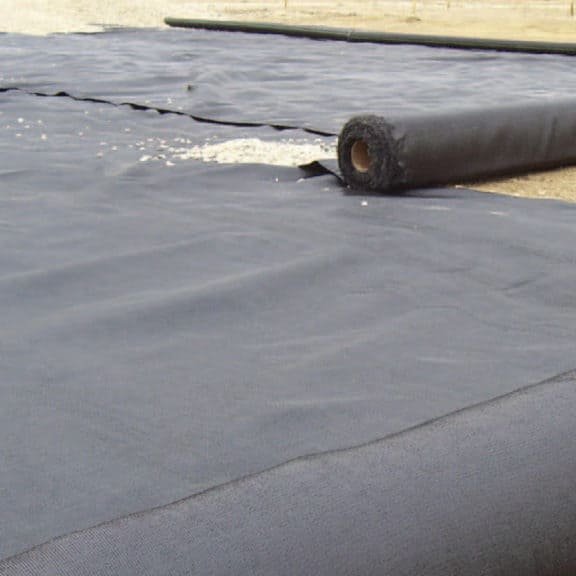
Woven geotextiles are widely used for:
- Road and highway reinforcement
- Railway track stabilization
- Soil reinforcement and load distribution
- Embankment and retaining wall construction
- Separation of weak subgrade soils
- Pavement and foundation stabilization
Purpose
The primary purpose of woven geotextiles is reinforcement and separation. Their high tensile strength enables them to withstand heavy loads, reduce rutting, and improve bearing capacity, making them especially suitable for roads, railways, and large infrastructure projects.
|
GSM Range
|
Strength & Properties
|
Typical Applications
|
|---|---|---|
|
100–150 GSM
|
Tensile strength ≈20–30 kN/m;
|
low elongation; lightweight Temporary roads, soil separation
|
|
150–250 GSM
|
Tensile strength ≈30–50 kN/m;
|
good dimensional stability Road subgrades, parking areas
|
|
250–350 GSM
|
Tensile strength ≈50–70 kN/m;
|
high load resistance Highway construction, embankments
|
|
350–500 GSM
|
Tensile strength ≈70–90 kN/m;
|
excellent reinforcement Railways, heavy traffic roads
|
|
500–600 GSM
|
Tensile strength ≈90–100 kN/m;
|
maximum strength Industrial pavements, ports, airports
|