
Coir Geotextile
Coir Geotextile
Kerala’s association with the coir industry dates back to the nineteenth century and is closely linked to its geography and culture. Situated between the Western Ghats and the Arabian Sea, the state enjoys a tropical climate that supports extensive coconut cultivation. The coconut palm plays a vital role in Kerala’s economy and daily life, so much so that the name Keralam is derived from the Malayalam words “kera” (coconut) and “alam” (land), meaning “the land of coconuts.”
Alappuzha (Alleppey) is the principal centre of coir production, where coconut husks are processed into fibres and converted into yarn, mats, ropes, and geotextiles. The coir industry, one of Kerala’s largest cottage industries, provides employment to over a million people, with women predominantly engaged in spinning and men in weaving. The historic port of Kochi further facilitated coir trade with foreign merchants, strengthening Kerala’s global commercial links.
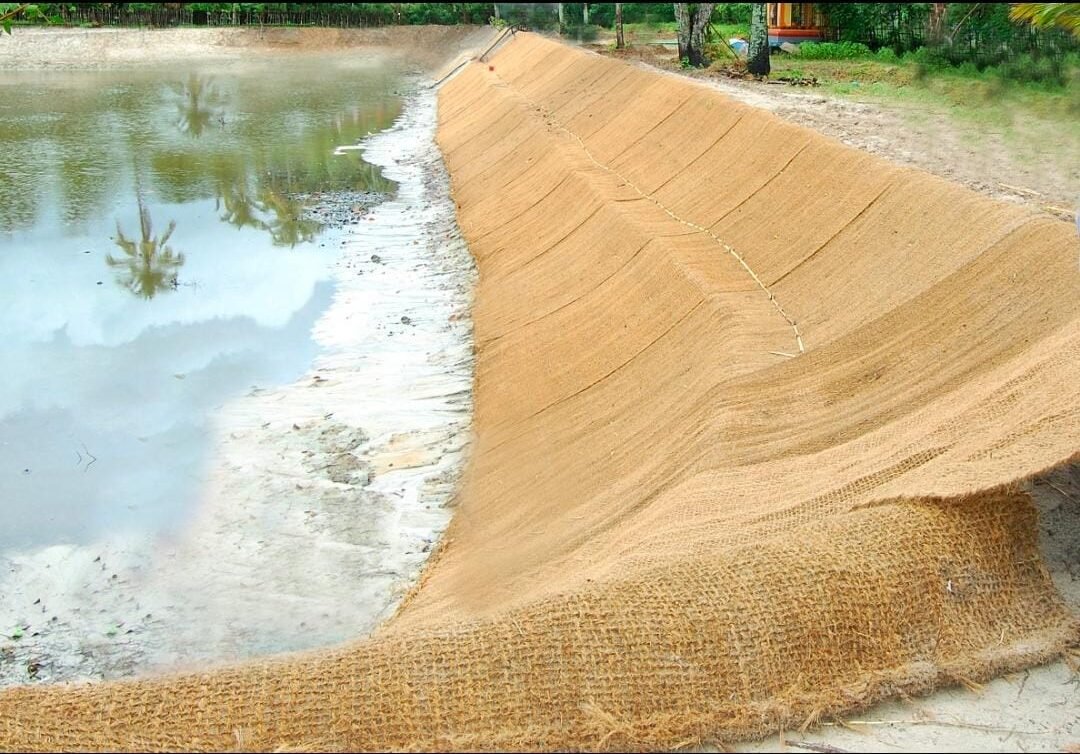
The tensile strength of coir geotextiles increases with GSM and typically ranges from 10 to 45 kN/m, while individual coir fibres exhibit tensile strengths of about 100–250 MPa. This strength, combined with good elongation and biodegradability, allows coir geotextiles to provide effective short- to medium-term soil stabilization.
Coir geotextiles are widely used for:
- Soil erosion control on slopes and embankments
- Riverbank and canal lining protection
- Road subgrade stabilization and embankment construction
- Coastal protection and dune stabilization
- Landscaping and vegetation support
Purpose
|
GSM Range
|
Strength & Properties
|
Typical Applications
|
|---|---|---|
|
400-500 GSM
|
Low to moderate tensile strength (≈10–15 kN/m); high flexibility; easy to handle and install
|
Surface erosion control, landscaping, seed stabilization, garden slopes
|
|
500–700 GSM
|
Moderate tensile strength (≈15–20 kN/m); good permeability; moderate durability
|
Riverbanks, canal slopes, low-height embankments
|
|
700–900 GSM
|
Medium tensile strength (≈20–30 kN/m); good soil retention; balanced strength and flexibility
|
Hill slopes, roadside protection, drainage works
|
|
900–1200 GSM
|
Medium to high tensile strength (≈30–40 kN/m); high durability; improved load-bearing capacity
|
Road subgrade stabilization, embankments, retaining slopes
|
|
1200–1400 GSM
|
High tensile strength (≈40–45 kN/m); reduced flexibility; maximum durability
|
Heavy-duty embankments, coastal protection, dune stabilization
|